One Time
The One-Time schedule template allows users to trigger a rule or workflow exactly once at a specified date and time. This is ideal for ad-hoc tasks, post-deployment validations, or one-off data integrity checks.
How To: Create a One Time Schedule
- Navigate to the Scheduler module.
- Select the Schedules tab to create a new schedule.
- Click New Schedule.
- Configuring schedule settings:
- Select Folder: To search for and select the appropriate workspace folder where the schedule will be stored.
- Input Schedule Name: Enter a descriptive and unique name to identify the schedule within the selected folder.
- Choose Template: Select One Time template.
- Enter the following details:
| Field Name | Description |
|---|---|
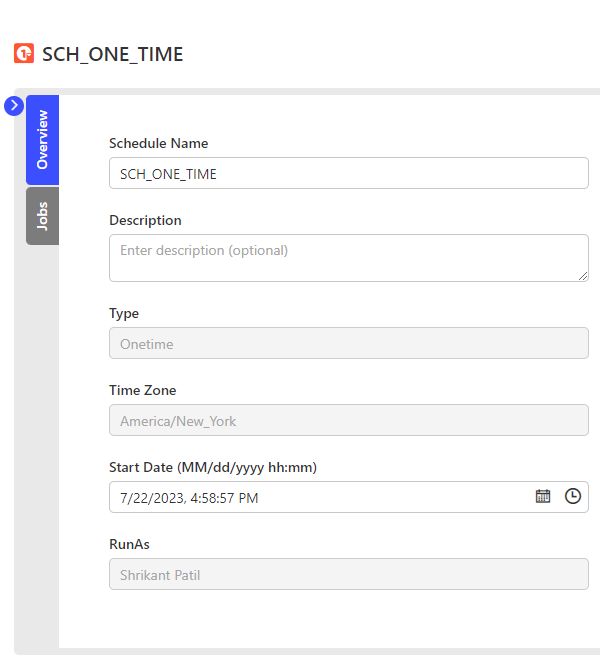
| Description (Optional) | A brief explanation providing business or technical context. |
| Start Date & Time | Choose the date using  and time using and time using  to select time. to select time. |
| Holiday Calendar (Optional) | Enable and select a predefined holiday calendar to skip execution on holidays. |
- In the Jobs tab, add the workflows to be triggered. Follow the below steps:
- Filter workflows by selecting specific folders using the ✔️ Checkmark icon.
- Use the
 button to search and add one or more workflows.
- Click Save to create the schedule.
- Once saved following options will be displayed:
- CRON Expression: The scheduler details selected above are converted to a CRON expression.
- Next Run: Displays the date and time of the next scheduled execution.
- Run As: Displays the username under which the jobs will be executed.
The following screenshot highlights the fields configured in a One-Time Schedule:
Video Guide
This video shows how to create a One Time Schedule.
Considerations
- Schedule names can include alphanumeric characters, hyphens (-), periods (.), at signs (@), spaces, and underscores (_).
- Each schedule name must be unique within a folder.
- Run As displays the user who created or last updated the schedule.
- You can pause a schedule using the Pause button.
- You can resume a paused schedule using the Resume button.
- Use the Run button to manually trigger the schedule. If the schedule is paused, the Run button is disabled.